
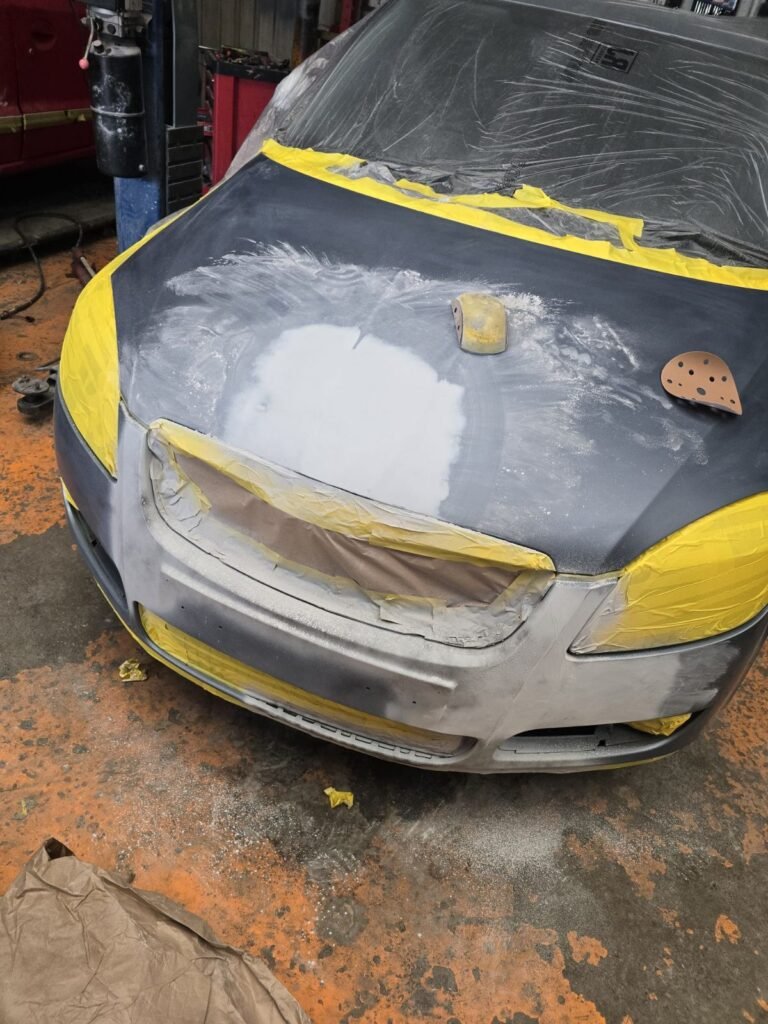
Photo: a front end filled, sanded and primed in our paint area. This is bodywork preparation for a paint repair, not polishing.
A fresh scratch on your car is frustrating, and the first question most drivers ask is whether it will simply polish out. Sometimes it will. Often it will look better but not disappear. And some scratches cannot be polished out at all, however much effort goes into them.
This guide explains what polishing actually does to your paint, which scratches it can improve, why deeper ones need a proper paint repair, and the common mistakes that turn a small mark into a bigger job.
How car paint is built up
Understanding the layers makes every other decision easier. Most modern cars have three main layers over the metal or plastic panel:
- Primer, which helps the paint stick and protects the panel underneath. It is usually grey, white or black.
- Base coat, which is the colour you see.
- Clear coat, sometimes called lacquer: a transparent top layer that gives the shine and protects the colour.
The whole paint system is very thin, and the clear coat is only part of it. Some older cars and some solid colours use a single-stage paint with no separate clear coat, which behaves differently again.
What car polishing actually does
Polish contains fine abrasives. It does not fill a scratch; it removes a very small amount of the top layer around it, levelling the surface so the edges of the scratch catch less light. On most modern cars that top layer is the clear coat; on single-stage paint it is the paint itself. How much is removed depends on the product and how it is used. A shallow scratch can disappear completely. A slightly deeper one may become much less visible but still be there when you look closely.
Some “scratch remover” products also contain fillers or glazes. These can hide fine marks for a while, but the marks often come back after a few washes because nothing has actually been levelled.
Polishing by hand and machine paint correction
Machine polishing, often called paint correction, uses a powered polisher with a series of cutting compounds and finer polishes. It can remove swirl marks and light scratches across whole panels far more evenly than hand polishing. It still works by removing a thin layer of the finish, so it has the same limit: it can only level damage that sits within that top layer.
Which scratches polishing can improve
Polishing usually helps with:
- fine swirl marks and wash marks, often from brushes or dirty cloths;
- light scuffs where another surface has rubbed against the paint;
- paint transfer, where a mark is a different colour from your car because it is paint from another object sitting on top of yours;
- shallow scratches that sit only in the clear coat.
Two simple checks give you a rough idea. Run a fingernail gently across the scratch: if your nail does not catch, it may be shallow enough to improve. Then wet the area: if the scratch almost disappears while wet, it is likely to be in the clear coat. Neither test is definitive, but both are a useful starting point.
Why deeper scratches usually need paint, not polish
If your fingernail catches, or the scratch looks white, grey or silver at the bottom, it may have gone through the clear coat into the colour, the primer or down to the panel. Polishing cannot put back layers that are missing. Trying to polish it out simply removes good clear coat from around the scratch until there is none left.
The colour you can see in the scratch can give a clue, but it is not a reliable guide on its own: primer colours vary between cars, and some layers look alike, so a close inspection is the only way to be sure.
- Same colour as the car, just duller: may be a clear coat scratch.
- White, grey or black: may be primer showing through.
- Bare silver metal: through to the panel. Get it looked at soon: exposed steel can start to rust, especially in wet weather. Plastic bumpers cannot rust, but a deep scratch in one still needs repairing properly to look right.
A proper paint repair means repairing and filling the damaged area where needed, sanding it smooth, priming it, then applying colour and clear coat and blending the repair into the surrounding paint so it matches. Metallic and pearl colours in particular need careful blending to look right from every angle. For a small chip or a short, narrow scratch, a careful touch-up can sometimes be enough.
Polishing, waxing and repainting: the difference
- Polishing corrects the surface by removing a tiny amount of the top layer: the clear coat, or the paint itself on single-stage finishes.
- Waxing, or applying a sealant, protects the paint and adds gloss. It sits on top and does not remove scratches, although it can make very fine marks less obvious for a while.
- Repainting replaces the damaged layers. It is usually the right fix for larger scratches that have gone through the clear coat, although small chips and short scratches can sometimes be touched up instead.
Common mistakes that damage paintwork
- Rubbing a dirty panel. Grit trapped in a cloth puts new scratches in the paint while you work. Wash and dry the area first.
- Using a heavy compound by hand in one spot. This can leave a dull, hazy patch that is more noticeable than the scratch was.
- Polishing edges and body lines hard. Paint is often thinner on edges and creases, and it is easy to rub through to the colour or primer there.
- Using a machine polisher without experience. A machine removes clear coat quickly, and once it has gone through, the only fix is paint.
- Repeating scratch-remover products. Each application removes a little more clear coat, and glazes can simply hide the problem.
- Working on a hot panel in direct sun. Products dry too fast and are harder to use evenly.
When to speak to a bodywork specialist
Get professional advice if:
- your fingernail catches in the scratch, or you can see primer or bare metal;
- the scratch runs across more than one panel, or along an edge or crease;
- it comes with a dent, a crack or a scuffed bumper;
- you have already tried polishing and it has left a dull patch.
Car polishing and scratch repair in Birmingham
Wali Auto Fix offers car polishing at our garage in Birmingham, as well as dent and scratch repairs and paintwork and resprays in our own paint area, where panels are repaired, primed, painted and blended to match the rest of the car. If a scratch is on a bumper, our bumper and panel repairs page explains how those are handled.
Having both under one roof means you do not have to guess which one your car needs. If polishing is likely to improve the marks, that may be all it takes; if a scratch has gone through the clear coat, we will explain why it needs a paint repair instead. Either way, we agree the work and the price with you before anything is done, and we will not promise that a scratch will polish out before we have seen it.
Our garage is at Unit 2, 12 Springfield Road, Birmingham B13 9NY, open Monday to Saturday from 9:30am to 6:00pm. Drivers from Moseley, Sparkhill, Hall Green and Acocks Green are close by, and we are within reach of Shirley and Solihull; all work is carried out at our Birmingham garage. The easiest way to start is to send photos: one of the whole side of the car, and close-ups of the scratch from two angles in good daylight.
Frequently asked questions
Will a scratch remover from a car accessories shop work?
On very light marks in the clear coat, it can help. It will not fix a scratch that has gone through to the colour or primer, and some products only hide marks temporarily. Test it on a small area first and stop if the paint starts to look dull.
Does polishing make the paint thinner?
Yes, slightly. Every abrasive polish removes a small amount of the clear coat, or of the paint on single-stage finishes. Careful polishing now and then is normal, but repeated heavy polishing of the same area can wear the clear coat away.
Can a deep scratch just be touched up?
A touch-up can seal a small chip or scratch and make it less noticeable, which is better than leaving bare metal exposed. It rarely makes a scratch invisible. For a repair that blends in, the area needs to be prepared and painted properly.
Ask about car polishing or scratch repair
Want your car polished, or not sure whether a scratch will polish out or needs paint? Send us photos for a bodywork quote, or call or WhatsApp us on 07300 506756 to ask about polishing. Directions are on our contact page.