

Photos in this article are from a real job in our workshop: a Honda HR-V whose front bumper was refinished while the rest of the car was masked. They start at the preparation stage, so they do not show the original damage. Number plates are blurred.
When the paint on one part of a car is scratched, scuffed or damaged, many drivers assume the whole car will need repainting to look right. In most cases it does not. A bodyshop can usually repaint just the damaged panel, such as a bumper, door or wing, and blend it to match the paint around it.
This guide explains the difference between a panel respray, a partial respray and a full respray, when each one makes sense, how a single-panel respray is done, and what decides whether the new paint will match.
A real panel respray from our workshop
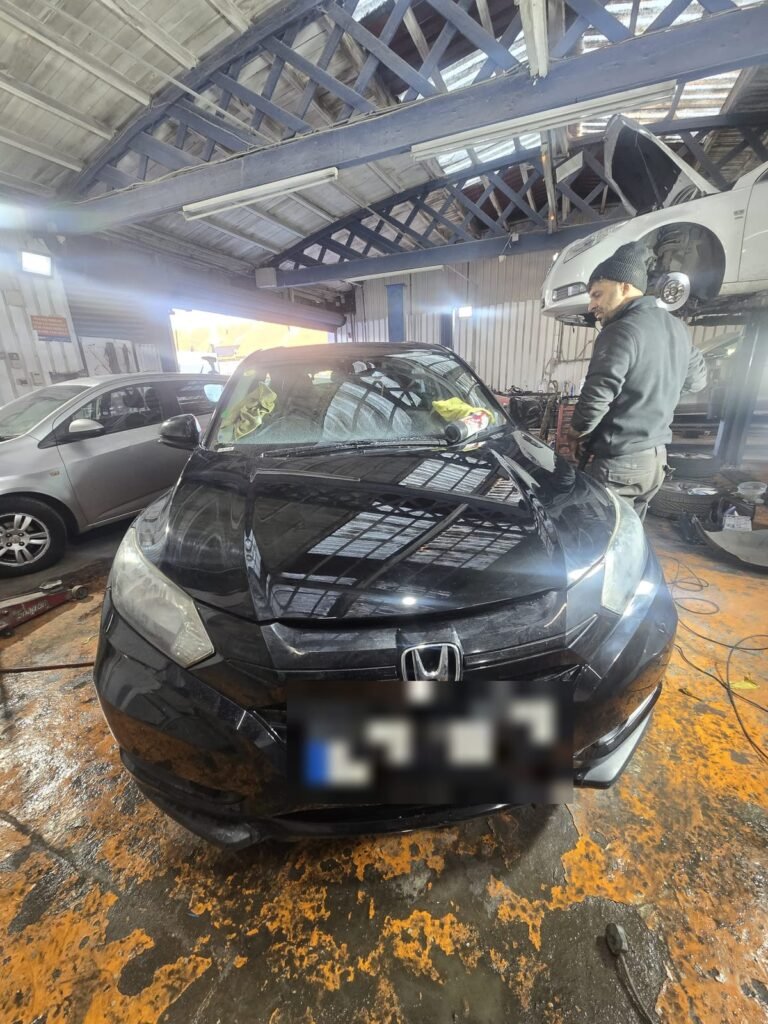
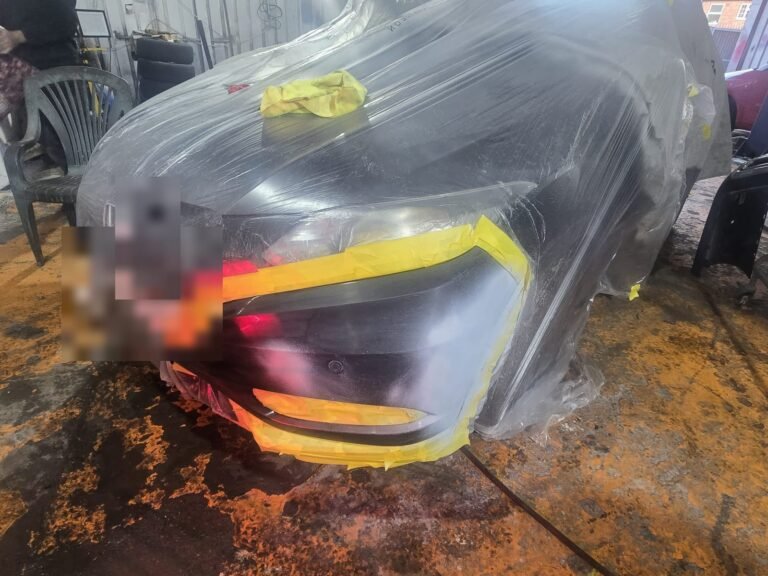
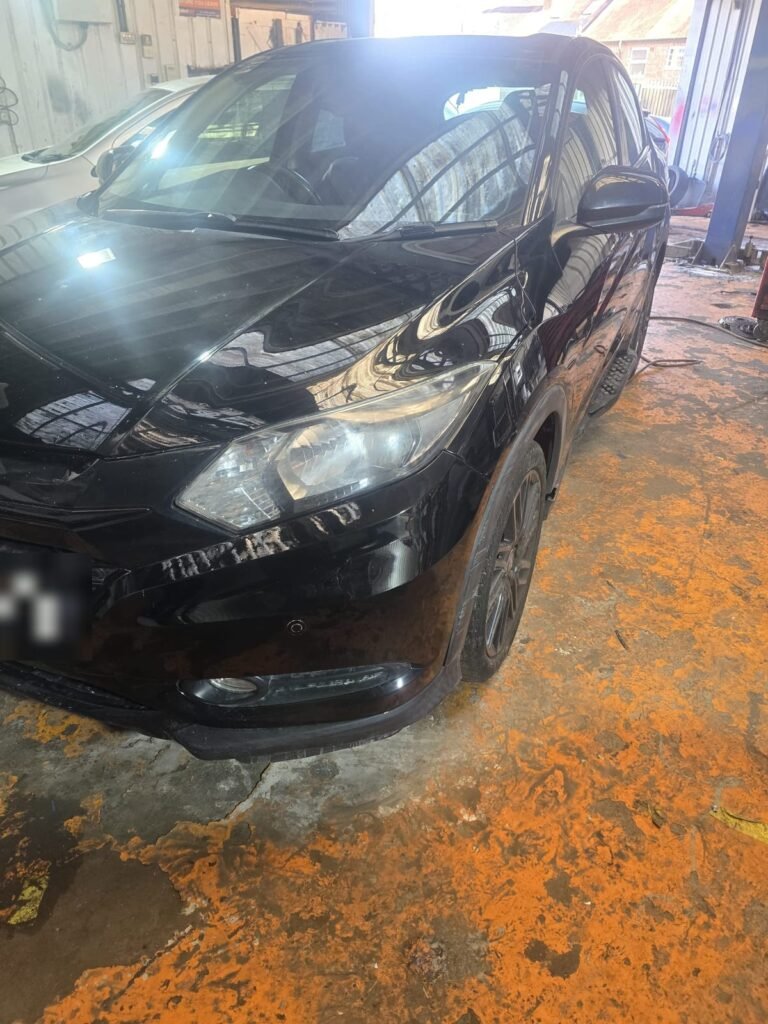
These photos show the same car. In the first, the car is in our workshop before its front bumper was refinished; the original damage is not visible in this photo. In the second, taken during preparation, the whole car is covered in plastic sheeting, and masking tape is run around the headlights and grille, so only the front bumper is exposed for painting. In the third, taken after refinishing, the front bumper has been painted and finished. Only one panel was painted; the bonnet, wings and the rest of the car kept their original paint.
Panel, partial or full respray: what is the difference?
- Panel respray: one panel, such as a bumper, door, wing or bonnet, is prepared and repainted. Paint may be blended into the edges of the panels next to it so the colour looks even.
- Partial respray: several panels are repainted, for example a whole side of the car after a scrape along two doors and a wing.
- Full respray: the whole outside of the car is repainted. Depending on the job, that can include door shuts, the inside of the boot lid and under the bonnet, which means much more stripping, masking and time.
Very small marks can sometimes be dealt with by polishing or a small localised repair without repainting a whole panel. Our article on whether polishing can remove scratches explains where that works and where it does not.
When a single-panel respray is usually enough
- The damage is limited to one panel, such as a scuffed bumper or a keyed door.
- A scratch has gone through the clear coat into the colour, so polishing will not remove it.
- A dent has been repaired and the panel needs repainting afterwards.
- The clear coat or paint is flaking on one panel, while the rest of the car is in good condition.
Repainting one panel also leaves the original factory paint on the rest of the car, which many owners prefer.
When a full respray makes more sense
- The clear coat is peeling, chalky or badly faded on many panels.
- Damage, rust repairs or scratches are spread right around the car.
- You want to change the colour of the car.
If you change your car’s colour, you need to tell the DVLA so your log book (V5C) shows the new colour. A respray in the same colour does not need to be reported.
How a panel respray is done
Every job is different, but a panel respray at a bodyshop usually follows these stages:
- Inspection: checking how deep the damage goes, whether there are dents or cracks, and whether the panel can be repaired.
- Repair and preparation: any dents or deep scratches are repaired, then the panel is cleaned, sanded and primed so the new paint has a smooth, sound surface to stick to.
- Masking: the rest of the car is covered with plastic sheeting, and lights, trim and edges are taped, so paint only goes where it is needed. You can see this stage in the second photo above.
- Colour: the colour is mixed from the car’s paint code and checked against the car itself, because paint can change slightly with age and sunlight.
- Painting: base colour coats are applied, then clear coat (lacquer) for gloss and protection. Where it helps the match, the colour is blended into the edges of the panels alongside.
- Curing and finishing: once the paint has hardened, the panel is checked in good light and finished so it sits in with the rest of the car.
On a bumper, parts such as grilles, trims and parking sensors may need removing or masking, and any parking sensors are checked afterwards.
Will a resprayed panel match the rest of the car?
A careful panel respray should be hard to tell apart from the panels around it. A few things make matching harder:
- Metallic and pearl colours: the flakes in the paint can look different depending on how the paint is applied, so these colours often need blending into the next panel.
- Older or sun-faded paint: the car may no longer be exactly the colour its paint code describes, so the mix is adjusted to suit the car.
- Bumpers next to metal panels: plastic bumpers and metal wings can look very slightly different even from the factory, so the match is judged by eye in good light.
If you know your car’s paint code, tell us when you ask for a quote. It is often on a sticker in a door shut or under the bonnet.
Panel respray or bumper replacement?
If a bumper is cracked, split or has broken mounting points, repainting alone will not fix it, and a repair or a replacement bumper may be needed first. Our guide to bumper repair or replacement explains how we decide.
Panel resprays at our Birmingham bodyshop
We repaint single panels, several panels and whole cars at our garage on Springfield Road, Birmingham B13, alongside dent, scratch and bumper repairs. See our paintwork and resprays, bumper and panel repairs and dent and scratch repairs pages, or other jobs on our Our Work page.
Drivers come to us from across Birmingham, including Moseley, Sparkhill and Hall Green, and from Solihull; all work is carried out at our Birmingham garage. If you cannot bring the car in, ask about our collection and delivery, subject to availability.
Frequently asked questions
How long does a panel respray take?
It depends on how much repair the panel needs before painting and how long the paint needs to cure. We will tell you how long we need the car when we agree the work.
Do I need to tell my insurer or the DVLA about a respray?
You must tell the DVLA if the car’s colour changes. Repainting a panel in the original colour does not need to be reported to the DVLA. If the repair is part of an insurance claim, your insurer will guide you.
Can you quote for a panel respray from photos?
Photos help us understand the damage and give you an idea of the options. Some repairs need an inspection before we can confirm the price, and we will tell you if that is the case. Our guide to taking photos for a bodywork quote shows what helps.
Get a panel respray quote
Send us photos of the damage for a bodywork quote: one of the whole side or end of the car, and close-ups of the damage from two angles in good daylight. You can also call or WhatsApp us on 07300 506756. Directions are on our contact page.