

Photos in this article are from a real job in our workshop: a silver Chevrolet Aveo being prepared for rear bumper refinishing. They show masking and preparation only. They do not show the original damage, and they do not show or prove that this particular car had peeling paint; the car is used here to illustrate how a bumper is prepared for refinishing. Number plates and people in the background are blurred.
Peeling or flaking paint is one of the most common problems with car bumpers. It might start as a small chip at a corner, then lift in flakes or whole sheets, showing grey primer or black plastic underneath. Once paint starts to lift, it rarely stops on its own.
This guide explains why bumper paint peels, why it can’t simply be touched up, how a plastic bumper is properly prepared and repainted so the new paint stays on, and what you can do in the meantime.
A rear bumper refinish from our workshop
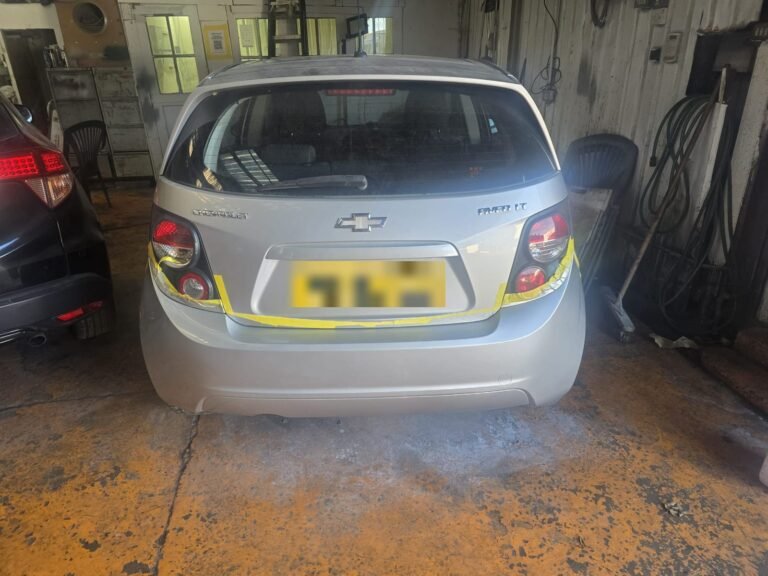

In the first photo, the Aveo is in our workshop. Masking tape runs around both rear light clusters and along the top edge of the rear bumper, where it meets the tailgate. In the second, taken during preparation for refinishing, the tailgate, rear window and lights are covered with masking paper and tape, and only the rear bumper is left exposed. The bumper is being prepared on the car rather than taken off, and the masking protects everything that is not being painted.
Why bumper paint peels
Most modern bumpers are made of plastic. Plastic flexes, expands and contracts more than steel, and paint does not bond to it as easily. That is why paint on bumpers lifts more often than paint on metal panels. Common causes include:
Poor preparation in an earlier repair
If a bumper has been painted before, the earlier repair is a common cause of peeling. Bare plastic needs to be thoroughly cleaned and keyed, and often treated with an adhesion promoter, before primer is applied. Paint sprayed over a contaminated, shiny or unprepared surface may look fine at first, then lift months later.
Chips and impact damage
A stone chip or a light knock can crack the paint without obviously damaging the bumper. Water and dirt then get under the edge of the chip, and the paint starts to lift outwards from there. Corners and lower edges are especially exposed.
Clear coat failure
The clear coat is the transparent top layer that protects the colour. After years of sunlight it can turn cloudy or white and then peel away, leaving the colour coat dull and unprotected underneath. This can happen on any painted panel, including bumpers.
Flexing and knocks
A bumper is designed to flex in a minor knock, but paint has limited flexibility. A bump that leaves no dent can still crack the paint, and those cracks are where peeling often begins.
Pressure washing and chemicals
A jet wash held close to a chipped edge can lift loose paint further. Strong chemicals and fuel spills can also attack paint that is already damaged.
Why peeling bumper paint can’t just be touched up
It is tempting to dab on touch-up paint or a quick coat from a spray can. The problem is that paint can only be as strong as the layer underneath it. If new paint goes over paint that is already lifting, the new layer comes off with the old one. Touch-up paint can protect a tiny chip for a while, but it will not fix an area that is flaking.
A lasting repair means removing the loose paint back to a firm, well-bonded edge, preparing the surface properly and rebuilding the layers. How much of the bumper that involves depends on the condition and extent of the paint failure: a small, contained area may only need a localised repair, while widespread peeling or clear coat failure usually means refinishing more of the bumper, or all of it, so the finish and colour are even.
How a plastic bumper is usually repainted
Every bumper and paint system is different, and the right method depends on the plastic and the paint manufacturer’s instructions. In general, the work goes through these stages:
- Assessment: checking how far the peeling goes, whether the plastic is cracked or damaged underneath, and whether parking sensors or other parts are affected.
- Removing loose paint: sanding away everything that is lifting until only firmly bonded paint remains, and feathering the edges so they do not show through.
- Cleaning: thorough degreasing, because plastic can hold contaminants that stop paint sticking.
- Treating bare plastic: where plastic is exposed, an adhesion promoter suitable for that plastic helps the primer bond.
- Primer: applied and sanded smooth to give an even base.
- Masking or removal: the bumper is either taken off the car or, as in our photos, prepared and painted in place with the lights, tailgate and body masked off.
- Colour and clear coat: the colour is sprayed, then a clear coat for gloss and protection. Some paint systems add a flexible additive for plastic parts.
- Finishing: once cured, the paint is checked and polished where needed, and the masking is removed.
Whether a bumper is painted on or off the car depends on the damage, the shape of the bumper and what is fitted to it. Both approaches can give a good result when the preparation and masking are done properly.
Matching silver and metallic bumpers
Silver and other metallic colours are among the hardest to match, because the metallic flakes in the paint reflect light differently depending on how it is sprayed. The colour starts from the car’s paint code and is checked against the paint on the panels around the bumper, which may have faded slightly with age. Sometimes the colour is blended into the neighbouring panels so there is no visible line.
What you can do in the meantime
- Avoid jet washing close to the peeling area, and do not pick at loose paint.
- Keep the area clean, so dirt does not get under the edges.
- If plastic is showing, it will not rust, but the peeling usually spreads, and a bigger area costs more to put right.
- If the bumper is cracked, loose or hanging, have it checked before you drive any distance.
Repair or replace a peeling bumper?
Peeling paint on its own is a paint problem, not a reason to replace the bumper. Replacement is usually only considered if the bumper itself is badly cracked, split or distorted. Our article on bumper repair or replacement explains how that decision is made, and our guide to panel respray or full respray explains why one panel can usually be painted on its own.
What affects the cost
We cannot give a fair price without seeing the bumper, because the cost depends on how much of it is peeling and whether a localised repair or a full bumper refinish is needed, whether the plastic is damaged, whether it is painted on or off the car, whether parking sensors or trims need removing, and the colour. We agree the work and the price with you before we start.
Bumper paint repairs in Birmingham
At Wali Auto Fix we repair, prepare and paint in our own workshop and paint area on Springfield Road, Birmingham B13. See our bumper and panel repairs, paintwork and resprays and dent and scratch repairs pages, or other jobs on our Our Work page. If the marks are only light scratches in the clear coat, our guide on whether polishing can remove scratches may help.
Drivers come to us from across Birmingham, including Moseley, Sparkhill and Hall Green, and from Solihull. All work is done at our Birmingham garage.
Frequently asked questions
Can you paint a plastic bumper?
Yes. Plastic bumpers are painted all the time, but they need the right preparation. Bare plastic must be cleaned, keyed and usually treated with an adhesion promoter before primer and paint, or the new paint may not stay on.
Can I touch up peeling bumper paint myself?
A tiny chip can be protected with touch-up paint, but paint that is already flaking needs the loose layers removed and the surface rebuilt. Painting over it usually means it peels again, taking the new paint with it.
Why is the paint peeling on a bumper that was repaired before?
A common reason is preparation: the plastic or old paint was not cleaned, keyed or treated properly before painting. The fix is to remove the failed paint and refinish the affected area properly; whether that is part of the bumper or all of it depends on how far the failure has spread.
Can you quote from photos?
Photos help us understand the damage and the options. Some repairs need an inspection before we can confirm a price, and we will tell you if so. Our guide to taking photos for a bodywork quote shows what helps.
Get a bumper paint repair quote
Send us photos for a bodywork quote: one of the whole end of the car, and close-ups of the peeling area from two angles in good daylight. You can also call or WhatsApp us on 07300 506756. Directions are on our contact page.